
The hardest part of a new habit isn't doing it. It's remembering to do it, every day, at roughly the same time, without relying on willpower. Habit stacking solves that by attaching each new habit to something you already do without thinking: after I pour my morning coffee, I'll write three lines in my journal.
The idea was popularised by James Clear in Atomic Habits, building on BJ Fogg's work on "anchors" in Tiny Habits. This guide shows how to design habit stacks and how to turn them into morning and evening routines in Notion that you can tick off in under a minute.
What Is Habit Stacking?
Habit stacking uses a simple sentence:
Your current habit — making coffee, brushing your teeth, sitting down at your desk — becomes the trigger for the new one. You don't need an alarm or a reminder; the old habit already happens every day. Chain several and you get a routine: one cue sets off the whole sequence.
Choosing Good Anchors
An anchor works when it is:
- Daily and reliable. "After I brush my teeth" happens every day. "After I go to the gym" doesn't.
- Specific. "After breakfast" is vague. "After I put my plate in the dishwasher" is a clear moment.
- Matched in place and time. Reading fits after getting into bed, not after parking the car.
Start with tiny new habits — one push-up, one line, one page. Once the stack runs automatically, make the habit bigger.
Example Habit Stacks


| Routine | After I… | I will… |
|---|---|---|
| Morning | pour my first coffee | write three lines in my journal |
| Morning | finish my journal lines | pick the one task that matters most today |
| Workday | sit down at my desk | close email and start a 25-minute focus block |
| Workday | close my laptop for lunch | walk for ten minutes |
| Evening | finish dinner | put tomorrow's gym bag by the door |
| Evening | get into bed | read ten pages |
Building Habit Stacks in Notion
You can run habit stacks on the same Habits database you may already use. Add four properties:
- Routine (select): Morning, Workday, Evening.
- Order (number): the position in the routine — 1, 2, 3.
- After (text): the anchor, e.g. "pour my first coffee".
- Done today (checkbox) or a relation to daily check-ins, if you track streaks.
Then create one view per routine: a list or board filtered to Routine = Morning, sorted by Order. Put the three views side by side on your dashboard, or show only the one that matches the time of day. If you track check-ins in a separate database, the daily habit tracking system guide covers the setup.


Formulas for Habit Stacks
Show the stack sentence on every card
Seeing the full sentence is what makes the cue stick. Add a formula called Stack:
if(empty(prop("After")), prop("Name"),
  style("After I " + prop("After") + ", ", "gray") +
  style("I will " + prop("Name") + ".", "b"))
A card then reads: After I pour my first coffee, I will write three lines in my journal.
Routine progress
On a Routines database (one row per routine, related to its habits), a progress line shows how far you are this morning:
lets(
  total, prop("Habits").length(),
  done, prop("Habits").filter(current.prop("Done today")).length(),
  repeat("●", done) + repeat("○", total - done) + "  " +
  format(done) + "/" + format(total)
)
It shows ●●○○ 2/4, which is all you need at 7 a.m.
Greeting by time of day
A small touch for the top of your dashboard that also hints which routine is next:
lets(h, hour(now()),
  if(h < 12, "Good morning — morning routine",
    if(h < 18, "Good afternoon — workday stack",
      "Good evening — evening routine")))
How to Make Habit Stacks Stick
- One new habit per stack at a time. Add the next link only when the current one is automatic.
- Keep routines short. Three to five habits per routine. A twelve-step morning routine breaks the first time you oversleep.
- Plan for bad days. Decide a minimum version in advance ("one line instead of three"). Our article on why you keep restarting habits explains why this matters.
- Review weekly. Which links did you skip? Usually the anchor is the problem, not the habit. Move it to a more reliable anchor.
- Track streaks per routine. A visible streak for "morning routine" is a strong reason not to break the chain. See our Notion streak formula.
Frequently Asked Questions
What is habit stacking?
Habit stacking means attaching a new habit to one you already do, using the sentence "After I [current habit], I will [new habit]". The existing habit becomes the cue, so you do not need reminders.
Who came up with habit stacking?
The term was popularised by James Clear in Atomic Habits. It builds on BJ Fogg’s idea of anchoring new behaviours to existing routines, described in Tiny Habits.
How do I build a morning routine in Notion?
Add a Routine select (Morning, Workday, Evening), an Order number and an After text property to your Habits database, then create a view filtered to Morning and sorted by Order. A formula can show the full stack sentence on each card.
How many habits should a routine have?
Three to five. Short routines survive busy and bad days; long ones break the first time something goes wrong.
Get It Ready-Made
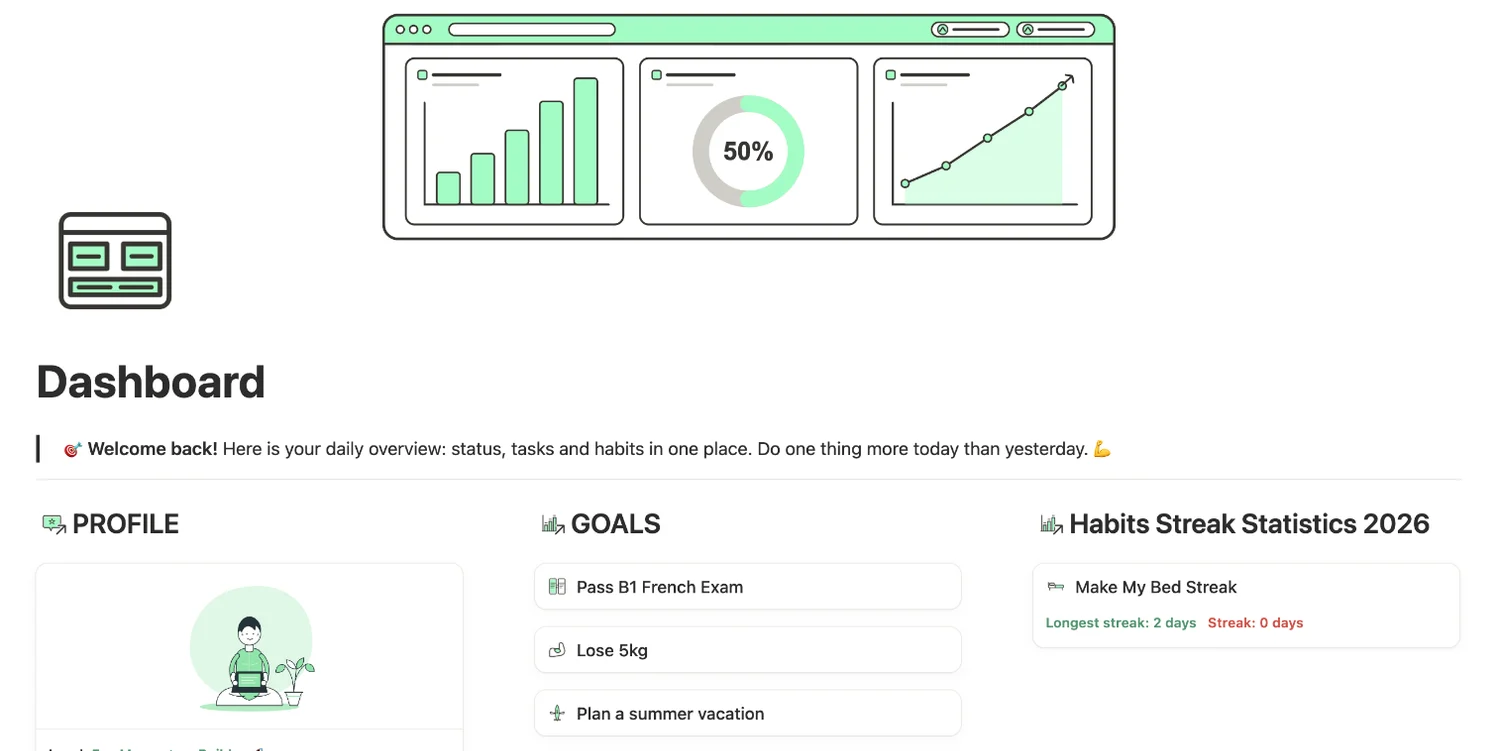
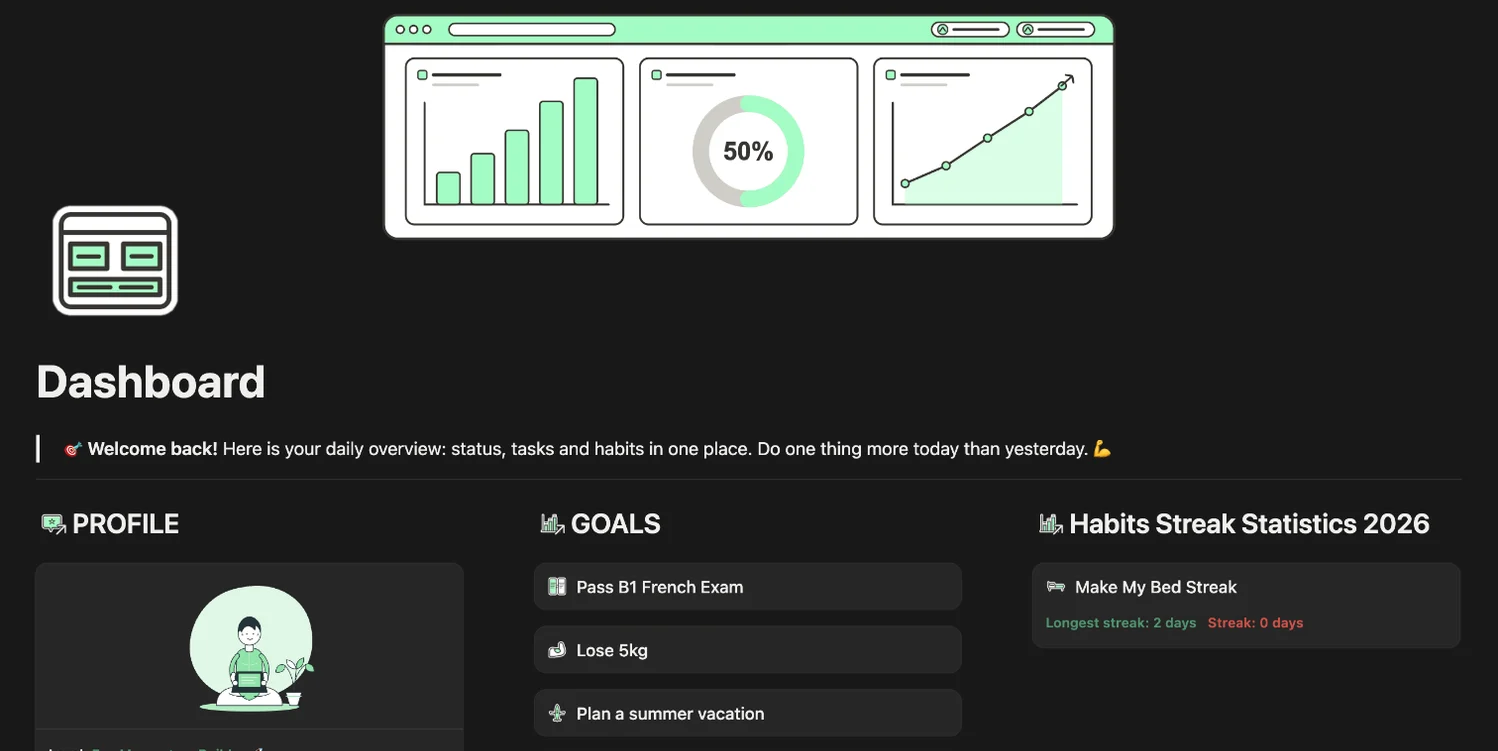
Consistency OS has morning and evening routines, habit streaks, XP and levels on one Notion dashboard. Works on the free Notion plan.
See Consistency OS — $19 →