
Most people don't fail to study because they're lazy. They fail because they're trying to rely on willpower — and willpower is a limited, unreliable resource. The solution isn't more motivation. It's better habits.
How Habits Actually Form
According to Charles Duhigg's research on habit formation, every habit runs on a three-part loop: cue → routine → reward. The cue triggers the behavior, the routine is the behavior itself, and the reward reinforces it. To build a study habit, you need to engineer all three parts deliberately.
Most people focus entirely on the routine (just study every day!) while ignoring the cue and reward. That's why their habits don't stick.
Step 1: Anchor Your Study Session to an Existing Habit
The most reliable cues are existing behaviors — things you already do every day without thinking. This is called habit stacking: attaching a new habit to an existing one.
Examples:
- "After I make my morning coffee, I open Notion and review my flashcards."
- "After I eat lunch, I spend 20 minutes on my most important study task."
- "After I brush my teeth at night, I write tomorrow's study plan."
The more specific and concrete the anchor, the more reliable the trigger. "In the morning" is too vague. "After I pour my first coffee" is actionable.
Get the 30-Day Habit Challenge
One habit, 30 days, a short prompt for every day. Get the free Notion template plus weekly habit tips.
Confirm your email and the template is yours. No spam, unsubscribe anytime.
Step 2: Make Starting Ridiculously Easy
The biggest obstacle to consistent studying isn't staying focused — it's starting. Use the two-minute rule: commit to just two minutes of studying. Open your Notion workspace, pick up one flashcard, read one page.
 The goal isn't to study for two minutes. The goal is to make starting so easy that you always do it — and once you've started, momentum usually carries you forward.
In Notion, this means keeping your study workspace set up and ready to go. Your daily review queue should be the first thing you see when you open the app, not buried three clicks deep.
Step 3: Design a Meaningful Reward
The reward doesn't have to be elaborate — it just has to create a positive feeling associated with the study session. Some ideas:
- Mark cards as "mastered" and watch your progress percentage tick up
- Log your session in a habit tracker (the satisfaction of an unbroken streak)
- Allow yourself 15 minutes of guilt-free entertainment only after studying
- Treat yourself to your favorite coffee or snack during study sessions
Step 4: Track Your Streak
Habit tracking works because it creates a visual representation of your momentum that you're reluctant to break. Jerry Seinfeld famously called this "don't break the chain."
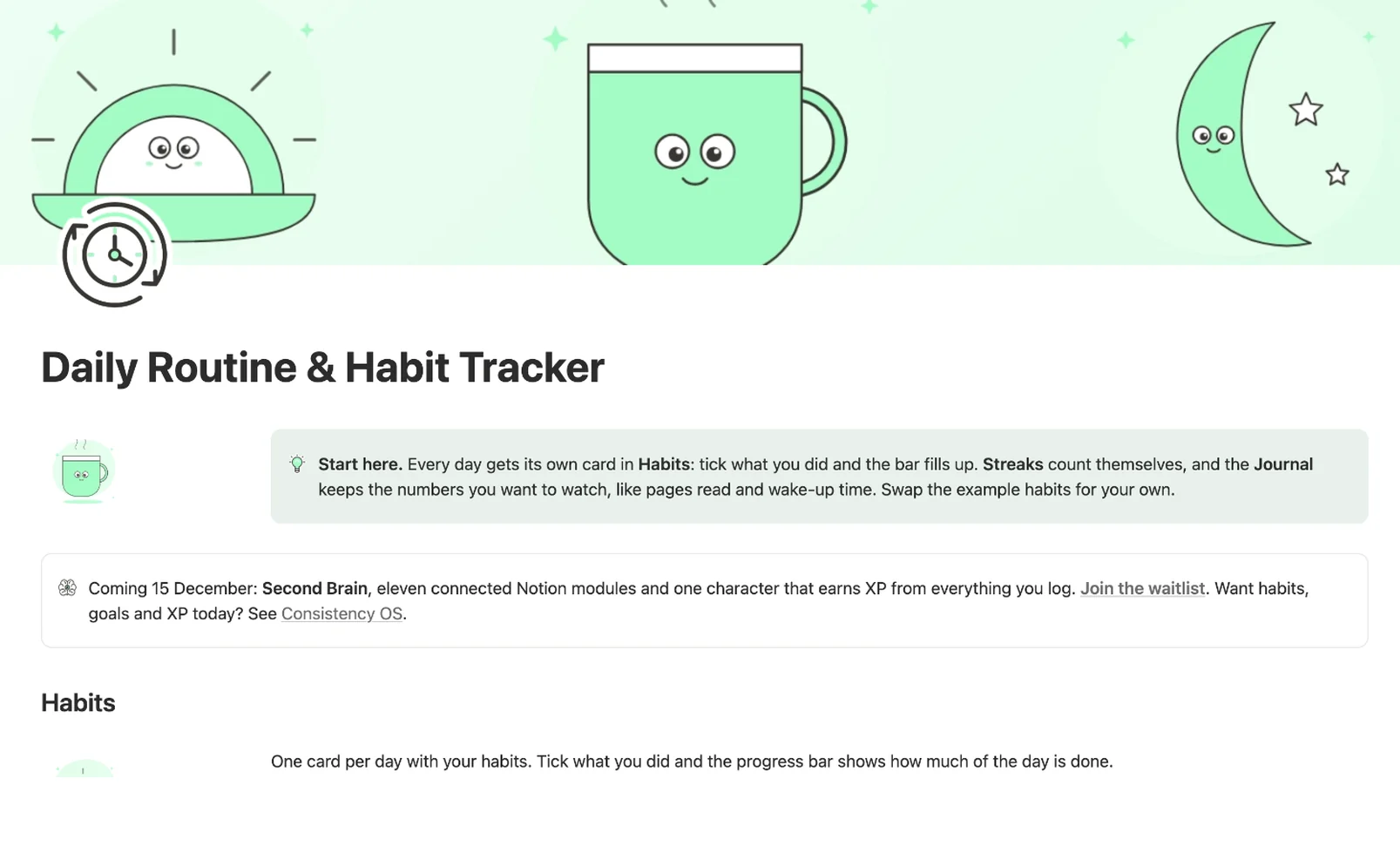
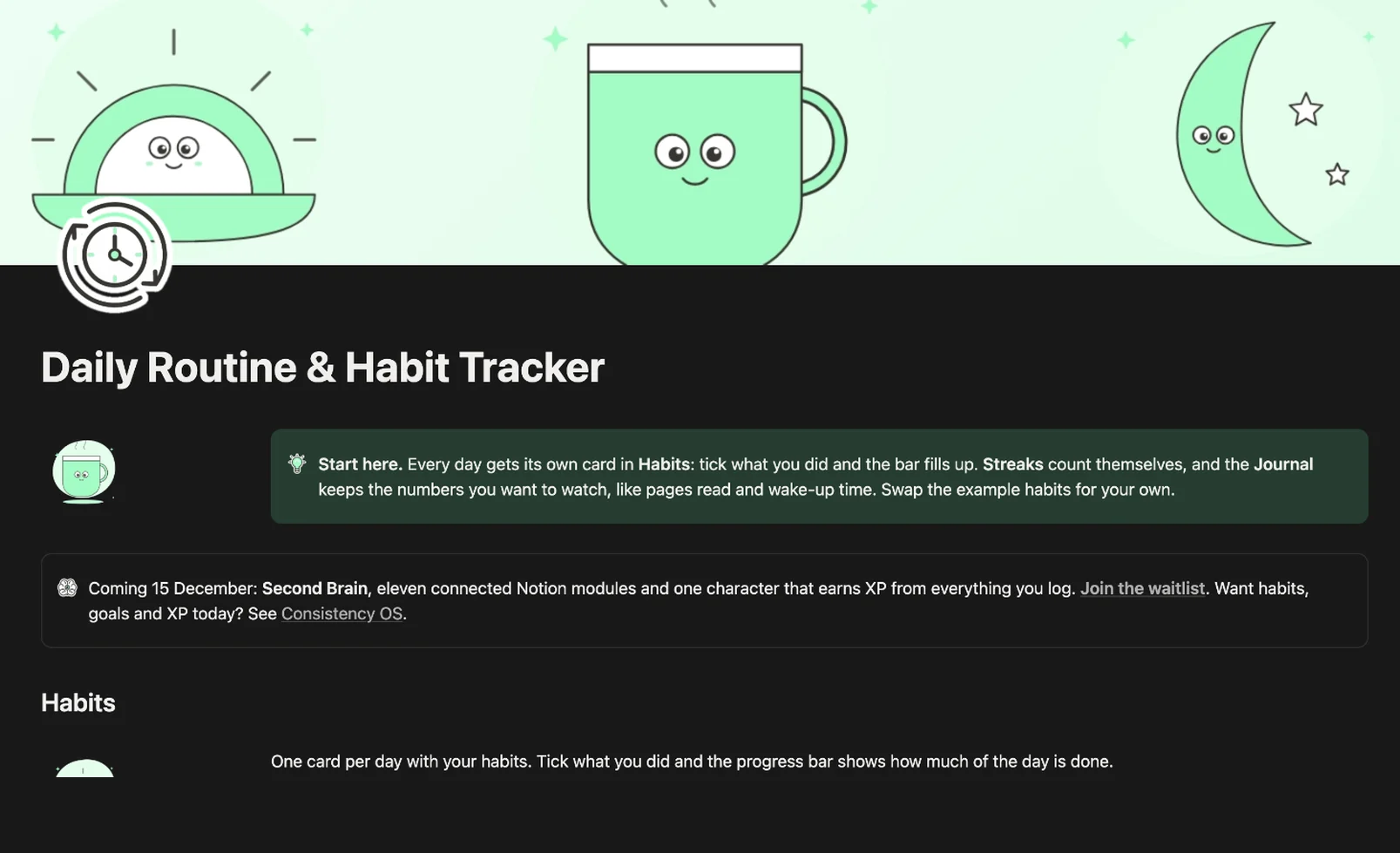
Our Habit Tracker template in Notion gives you a visual calendar of completed days, a streak counter, and weekly summary stats. Seeing a 14-day streak makes it psychologically difficult to miss a day — which is exactly the point.
If streaks alone stop motivating you after a few weeks, add a second layer: points and levels. Consistency OS turns every completed habit and task into XP, tracks your current and longest streak for each habit, and levels you up as you stay consistent — so progress feels like a game you don't want to quit.
When You Miss a Day
You will miss a day. Everyone does. The critical rule: never miss twice. Missing one day is an accident. Missing two days is the start of a new (bad) habit. Get back on track immediately, without guilt or self-recrimination, and the streak will rebuild quickly.
It also helps to plan for bad days in advance. In Consistency OS you can use a Freeze Day to protect a streak when you're sick or travelling, and log what got in the way in the Friction Log — so a missed day becomes data instead of a reason to quit.
Want the full picture? Read our complete guide to using Notion for studying — notes, flashcards, spaced repetition and planning in one system.
Keep reading: why you keep restarting habits · how to gamify your habits in Notion · best Notion habit tracker templates
Track Your Study Habit in Notion
Our Habit Tracker template gives you streaks, weekly stats, and visual calendar tracking to keep you consistent.
Get Habit Tracker →